Consider it a sign of the times, you can now control and track rail cars from your cellphone
Click here for more information

International Transport and Logistics: Operations and Management --- Conservatoire National Des Arts et Métier
Thursday, March 31, 2011

Friday, March 25, 2011
Professor Vukan R. Vuchic, Docteur Honoris Causa
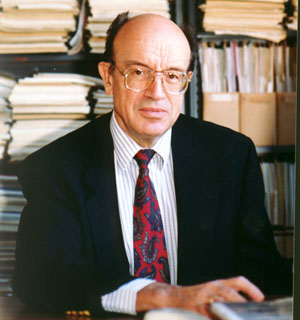 On March 10, 2011, CNAM presented Professor Vukan R. Vuchic with the title of Honorary Doctorate. Born in 1935 in Belgrade, Vukan R. Vuchic graduated from the University of Belgrade in 1960. He began his career as an engineer in Europe before moving to the United States where he graduated in 1965 with a PhD from the University of Berkeley. He obtained American citizenship in 1968, and has become the international academic reference for engineering of onboard systems applied to transportation. Professor at the University of Pennsylvania. Prof. Vuchic is now in charge of the UPS Foundation Chair dedicated to this theme. Through his expert advisory role with companies and public authorities, Vukan R. Vuchic has greatly influenced the construction of urban transport networks throughout the world. He is among the engineers who have received the highest number of distinctions in this century and is the author of many international publications and reference books.
Click here for more details
Thursday, March 24, 2011
Tuesday, February 8, 2011
Vice President Biden Announces Six Year Plan to Build National High-Speed Rail Network

Philadelphia, PA - Vice President Joe Biden today announced a comprehensive plan that will help the nation reach President Obama’s goal of giving 80 percent of Americans access to high-speed rail within 25 years, as outlined in his State of the Union address. The proposal will place high-speed rail on equal footing with other surface transportation programs and revitalize America’s domestic rail manufacturing industry by dedicating $53 billion over six years to continue construction of a national high-speed and intercity passenger rail network. As a part of President Obama’s commitment to winning the future by rebuilding America’s roadways, railways and runways, the plan will lay a new foundation for the nation’s economic opportunity, job creation, and competitiveness.
The Vice President made the announcement with Transportation Secretary Ray LaHood during a visit to Philadelphia’s historic 30th Street Station, where passengers traveling from Pittsburgh and Harrisburg on Amtrak’s Keystone Corridor connect to high-speed Acela service to Boston, New York City, and Washington, D.C. Since track improvements raised speeds between Harrisburg and Philadelphia to 110 mph in 2006, the Keystone Corridor has seen rail ridership rise by 57 percent. In fact, more passengers now travel from Harrisburg to Philadelphia – and from Philadelphia to New York City and Washington D.C. – by rail than by plane.
“As President Obama said in his State of the Union, there are key places where we cannot afford to sacrifice as a nation – one of which is infrastructure,” said Vice President Biden. “As a long time Amtrak rider and advocate, I understand the need to invest in a modern rail system that will help connect communities, reduce congestion and create quality, skilled manufacturing jobs that cannot be outsourced. This plan will help us to do that, while also increasing access to convenient high speed rail for more Americans.”
As the first step in this comprehensive, six-year plan, the President’s Budget for the coming fiscal year would invest $8 billion in expanding Americans’ access to high-speed passenger rail service. In order to achieve a truly national system, these investments will focus on developing or improving three types of interconnected corridors:
- Core Express: These corridors will form the backbone of the national high-speed rail system, with electrified trains traveling on dedicated tracks at speeds of 125-250 mph or higher.
- Regional: Crucial regional corridors with train speeds of 90-125 mph will see increases in trips and reductions in travel times, laying the foundation for future high-speed service.
- Emerging: Trains traveling at up to 90 mph will provide travelers in emerging rail corridors with access to the larger national high-speed and intercity passenger rail network.
This system will allow the Department – in partnership with states, freight rail, and private companies – to identify corridors for the construction of world-class high-speed rail, while raising speeds on existing rail lines and providing crucial planning and resources to communities who want to join the national high-speed rail network. With rail ridership reaching all-time highs in many areas of the country during 2010, these investments will ensure that more Americans have the option of taking a train to reach their destination.
"In America, we pride ourselves on dreaming big and building big," said Secretary of Transportation Ray LaHood. "This historic investment in America’s high-speed rail network keeps us on track toward economic opportunity and competitiveness in the 21st century. It’s an investment in tomorrow that will create manufacturing, construction, and operations jobs today.”
This long term commitment builds on the $10.5 billion down payment the Obama Administration already devoted to a national high-speed rail system – including $8 billion of Recovery Act funds and $2.5 billion from the 2010 budget. These investments are already paying economic dividends in places like Brunswick, Maine, where construction workers are laying track that will provide the first rail service since the 1940s from Brunswick to Portland to Boston. Private dollars are also gravitating toward Brunswick’s station neighborhood, as investors have financed a number of businesses and residential condos, a new movie theatre, a new 60 room hotel, and a 21st century health clinic. Similar high-speed and intercity passenger rail projects across the country will create jobs not only in our manufacturing sector, but also in the small businesses that open near modernized train stations. They will connect large metropolitan communities and economies through a safe, convenient, and reliable transportation alternative. They will ease congestion on our roads and at our airports. And they will reduce our reliance on oil as well as our carbon emissions.
By clarifying the long-term federal role in passenger rail, this six-year program will provide states and cities with the certainty they need to make long-term transportation plans for their communities. It will provide businesses the confidence they need to hire American workers. Strong Buy American requirements will create tens of thousands of middle-class jobs in construction, manufacturing, and rail operations. And the proposal will open the door to new public-private partnerships, and attract significant private investment in developing and operating passenger rail corridors.
The proposal announced today by the Vice President also streamlines the Department of Transportation’s rail programs, making it simpler for states, cities, and private companies to apply for grants and loans. For the first time, all high speed and intercity passenger rail programs will be consolidated into two new accounts: a $4 billion account for network development, focused on building new infrastructure, stations, and equipment; and a $4 billion account for system preservation and renewal, which will maintain state of good repair on Amtrak and other publicly-owned assets, bring stations into Americans with Disabilities Act compliance, and provide temporary operating support to crucial state corridors while the full system is being built and developed.
Thursday, January 27, 2011
Rail Transit Safety: Is There a Real Difference Between Cities?

Presented at the 90th Annual Meeting of the Transportation Research Board
Rail Transit Systems: System Development, Safety, and Reliability
January 26, 2011 | 4:30 pm | Columbia Hall 8: Washington Hilton , Washington
In December 2009, the US DOT proposed to establish and enforce minimum Federal safety standards for rail transit systems to correct the status quo condition where 27 separate state programs are responsible for rail safety “resulting in a situation in which there are inconsistent practices and effectiveness”. This short paper conducts a statistical analysis of publicly available safety data to empirically address two questions:
- How safe is rail transit compared with other modes of transport?
- Is there a statistically significant record of inconsistent safety among rail transit agencies?
Tuesday, November 30, 2010


Tuesday, November 23, 2010
Final Syllabus Revision
Class | Topic(s) | Reading Assignment |
1 F 15/10 | Course Introduction Student Introductions Review of Syllabus | None |
2 M 18/10 |
| US DOT: Transit Cooperative Research Program: Report 100: Transit Capacity and Quality of Service Manual-2nd Edition Washington DC 2003 pp 1-7 to 1-22 |
3 F 22/10 pm only |
| John H. Armstrong “The Railroad: What It Is, What It Does” Simmons-Boardman Books, Incorporated 1994 pp. 1-14 and 27-42 |
4 M 25/10 | David O. Nelson and Kay O’Neil, “Commuter Rail Service Reliability: On-Time Performance and Causes for Delays” Transportation Research Record: Journal of the Transportation Research Board Transportation Research Board of the National Academies; Washington DC Volume 1704 pp 42-50 Year 2000 First student presentation
| |
5 F 29/10 | US DOT: Transit Cooperative Research Program: Report 118: Bus Rapid Transit Practitioner’s Guide | Chapter 2. Planning Framework pp 2-1 to 2-12 | Chapter 4. Component Features, Costs and Impacts pp 4-1 to 4-45 | |
6 5/11 pm only |
| US DOT: Transit Cooperative Research Program: Report 100: Transit Capacity and Quality of Service Manual-2nd Edition Washington DC 2003 Part 7 Chapter 3 Passenger Circulation and Level of Service pp 7-7 to 7-21 |
7 8/11 am with 2nd Years | US Freight and Supply Chains (Part 1) | Scott M. Dennis, Ph.D. A Decade of Growth in Domestic Freight. Rail and Truck Ton-Miles Continue to Rise Bureau of Transportation Statistics Special Report Supplemental Richard Hillestad, Ben D. Van Roo, Keenan D. Yoho Fast-Forward: Key Issues in Modernizing the |
8 8/11 pm |
| None |
9 15/11 am with 2nd Years | US Freight and Supply Chains (Part 2) | Scott M. Dennis, Ph.D. A Decade of Growth in Domestic Freight. Rail and Truck Ton-Miles Continue to Rise Bureau of Transportation Statistics Special Report Supplemental Richard Hillestad, Ben D. Van Roo, Keenan D. Yoho Fast-Forward: Key Issues in Modernizing the |
10 15/11 pm | David O. Nelson and Tara Blakey “Regional Rail: Scheduling for Connections” Transportation Research Record: Journal of the Transportation Research Board, Transportation Research Board of the National Academies Washington DC Volume 2112 pp: 77-85 Year 2009 Second student presentation Transit Transfer Report | |
11 19/11 pm only | American Association of | |
12 22/11 am with 2nd Years | Intermodal Freight Transport Containerization (Sea and Land) | The Intermodal Container Era: History, Security, and Trends Transportation Research News Number 246: September-October 2006 (pp 5-9) |
13 22/11 Pm |
| David O. Nelson & Kay O’Neil, “Urban Transport Investment Options for Developing Asia: Considerations Leading to a Balanced Sustainable Network” CODATU XIII November 12-14, 2008 |
14 26/11 am |
| David O. Nelson and Yawa Duse-Anthony MBTA I-90/I93 Coordination Contract, Coordination, Planning and Conceptual Design Services “ Final Student Presentation Transport Terminal Report |
15 26/11 pm | Mega Projects and Course Evaluation | None |
Subscribe to:
Posts (Atom)